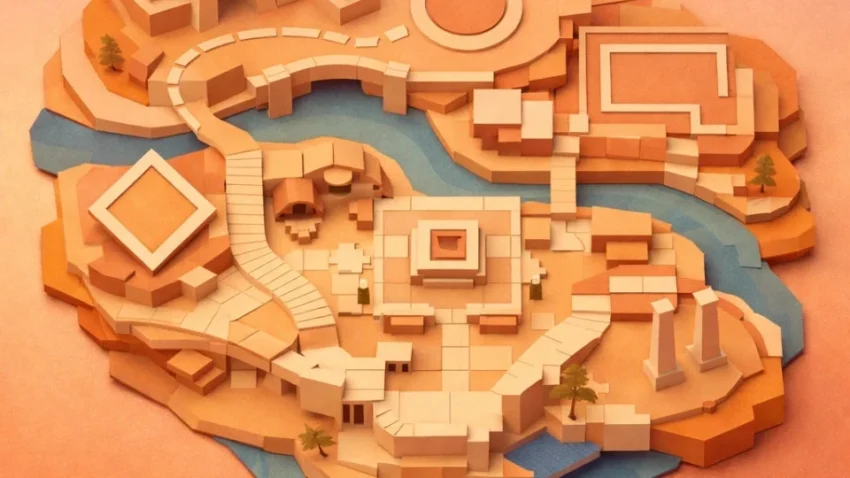
Knowing where Anubis leads is not the same as knowing when a route matters. Many rounds are lost when a team turns early pressure into an early commitment, or when defenders give up information while waiting for an attack that never comes.
The stronger approach is to treat the map as a network of decisions. Mid pressure, side-lane presence, utility and rotations should all answer the same question: what does this force the other team to reveal, spend or defend?
How Anubis Rewards Map Control Over Early Fights
Anubis is shaped by connected movement. Water routes, Mid, site entrances and rotation paths can all alter the direction of a round, so the first duel is rarely the only meaningful event. A team that gains space without losing players can create pressure elsewhere, make rotations more difficult and keep its opponents guessing.
Mid is especially valuable because it produces choices for both sides. Controlling it can force defensive utility, restrict Counter-Terrorist information, open access to Connector or create the threat of a rotation. None of that requires an immediate elimination. Often, the gain is that the defence has to respect several possibilities at once.
That is why patience matters. Anubis rewards situational awareness, tactical sense and attention to sound cues more than a habit of forcing the first available fight. Take space with a reason, then decide whether the response gives you a better final call.
Learn the Routes That Change the Round
Start with Mid because it is the map’s central decision area. It links pressure to Connector and can influence how comfortably either side moves between responsibilities. If Mid is contested, both teams must account for the possibility that pressure will spill into another route rather than remain a simple head-to-head fight.
Connector is therefore more than a name to memorise. It is a route whose value rises when Mid control is uncertain. A team that can influence Connector can affect information, movement and the defence’s ability to read where the round is heading.
Beyond Mid, learn Canal, A side, B side and the Counter-Terrorist rotation routes as parts of one connected picture. Bridge, B Long and A Main also matter because movement through them can change the pressure placed on a site or the route available after a defender responds.
The useful habit is to ask what each route means at that moment. Is it a way to pressure a side? A path that threatens a rotation? A lane that needs watching because the other team may use it to gather information? Route knowledge becomes valuable when it changes a call, not when it is merely a list of map labels.
Use Utility to Create Decisions, Not Just Damage
Utility on Anubis should have a job. Around Mid, it can apply pressure, force a defensive response, deny information or help establish control of Connector. The point is not simply to throw grenades because the round has started; it is to make the opponent choose between spending resources, yielding space or exposing a response.
For Counter-Terrorists, layered utility can support a defensive setup while the team works out what the Terrorists are showing. One layer can slow or challenge pressure, while another remains available for the next decision. This makes utility part of information management rather than a substitute for it.
Specific lineups, landing points and execute timings need to be learned separately. The transferable rule is simple: before using utility, agree on the information or movement it is meant to create.
Terrorist Plan: Default, Pressure, Then Commit
Terrorists are trying to plant the bomb, but the best route to a plant is not always an instant site rush. A useful default spreads pressure safely, avoids giving away free eliminations and aims to establish Mid control plus at least one side lane.
That structure preserves the final site choice. If the defence spends utility or shifts attention to Mid, reassess the side lanes. If a route creates a rotation opportunity, use the new pressure rather than committing out of habit. The default has worked when it leaves the defence stretched and gives your team a clearer reason to choose its finish.
Counter-Terrorist Plan: Protect Sites While Finding Information
Counter-Terrorists must prevent the plant, but a defence that keeps all five players deep on bombsites gives up too much control. The goal is to protect the sites while actively seeking enough information to understand whether Terrorist pressure is real, delayed or shifting through the route network.
Early information, layered utility and crossfires can all form part of that plan. The important distinction is discipline: information should improve the team’s next decision, not become an isolated risk. When control has been lost or the attack is developing, a measured retake decision may be stronger than several disconnected attempts to recover space.
What the CS2 Transition Changed—and What Still Matters
Anubis entered the Counter-Strike 2 Limited Test in August 2023, accompanied by visual lighting changes. At that point, it was described as largely unchanged from its Counter-Strike: Global Offensive version apart from those lighting adjustments.
That context is useful, but it should not be stretched into a claim about the current state of the map. There is no confirmed basis here for judging later update effects, precise gameplay changes or whether Anubis now favours Terrorists or Counter-Terrorists overall.
The enduring lesson is more practical anyway. A connected map still asks teams to manage information, pressure and rotations. Players who understand why Mid matters, when a side lane must be respected and how utility changes a defender’s choices will make better calls regardless of visual presentation.
A Round-by-Round Anubis Decision Checklist
Before the round begins, give the team a shared objective rather than a vague instruction to “take a site.” Terrorists should decide which areas need early attention: Mid, a side lane, or both. Counter-Terrorists should decide how they will protect the sites without becoming blind to map movement. The call does not need to predict every fight; it needs to establish what information will matter first.
At the start of a Terrorist round, ask whether the spread is creating pressure without donating a free elimination. A safe default is not passive if it makes defenders account for Mid and at least one side lane. Keep A Main, B Long, Bridge, Canal and the wider route network in mind as potential sources of pressure, movement or defensive reaction. Do not confuse occupying a route with having a reason to commit through it.
As Mid is contested, make the next decision explicit. Did the defence use utility? Did it reveal a player? Has access to Connector become more valuable? Has pressure caused a possible rotation? Mid control is useful when it changes the defence’s choices. If it has not yet done that, there may be no need to force the round forward.
Use utility with a stated purpose. On attack, its purpose may be to pressure Mid, deny Counter-Terrorist information, draw out a response or support a move toward Connector. On defence, it may be part of a layered setup that buys time while teammates collect information. In either case, follow the utility with a question: what can we now learn, take or threaten that we could not before?
When the round reaches its middle phase, reassess the final site choice instead of treating the original plan as fixed. Terrorists should look for whether Mid and side-lane pressure have kept both sites plausible. If they have, the defence may be stretched across A side, B side and rotation routes. If not, the team may need to preserve players and rebuild pressure rather than rush into a prepared response.
For Counter-Terrorists, the mid-round check is whether site protection is still balanced with information. Have you learned enough to make a useful rotation? Are teammates covering the routes that now matter most? Is a crossfire possible if pressure arrives, or is the team reacting as isolated players? A rotation should answer a clear threat, not simply the first sign of noise or utility.
Finally, keep each side’s objective in view. Terrorists need to create the conditions for a plant, while Counter-Terrorists need to deny that plant and make any later recovery deliberate. The best Anubis calls are usually not the fastest ones. They are the calls made after pressure has produced information, routes have preserved options and the opposing team has been forced to show its hand.