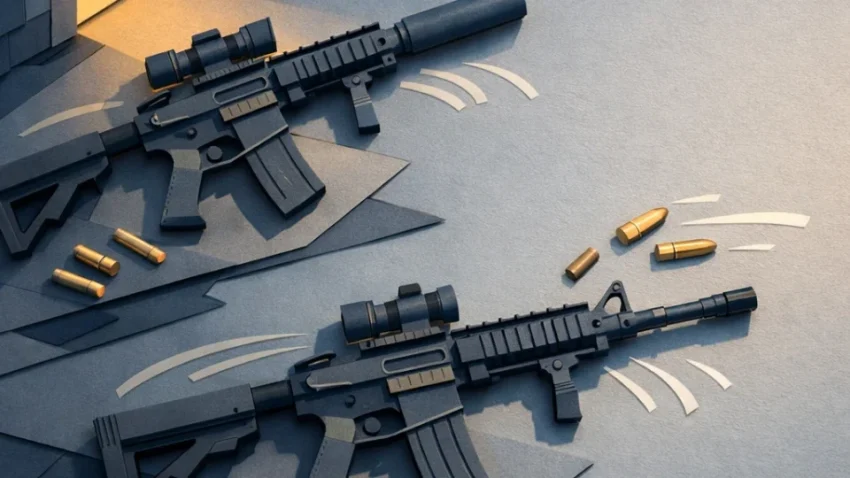
The M4A4 and M4A1-S are alternative CT primary-rifle choices, and neither is the automatic best pick for every player. The M4A4 is built around faster multi-shot pressure, making it the stronger fit for hectic close-range fights. The M4A1-S trades some of that firing speed for easier control, tighter spread, stronger first-bullet handling and suppressed utility.
Because both rifles now cost the same, the decision is less about economy and more about the situations you expect to face. If you regularly take fast, close engagements and want every advantage when several bullets need to land quickly, lean M4A4. If you prefer controlled shots, calmer sprays and lower-profile fire through smoke, the M4A1-S is usually the more comfortable rifle.
M4A4 vs M4A1-S: the quick choice
Choose the M4A4 when your CT rounds often involve close-range contact, rapid follow-up shots and aggressive multi-shot duels. Its faster rate of fire matters most when an opponent survives the first bullet and the fight becomes a race to land the next few. It rewards players who are comfortable committing to a more demanding spray.
Choose the M4A1-S when you want a more controlled rifle for deliberate engagements. Its tighter spread, improved first-bullet accuracy and easier recoil control make it a natural fit for players who value clean opening shots and measured bursts. The suppressor also gives it tactical value when firing through smoke or trying to reveal less through sound.
The practical split is simple: the M4A4 favours pressure; the M4A1-S favours control. That does not mean the M4A4 cannot take longer fights or that the M4A1-S is weak up close. It means their strongest qualities show up in different kinds of exchanges.
Damage and fire rate in close fights
At close range, the M4A1-S deals 38 damage per bullet, while the M4A4 deals 33. Against an armoured opponent, that can make a meaningful difference: the M4A1-S can secure the kill with four body shots, whereas the M4A4 will typically need five. On a purely per-bullet basis, the silenced rifle has the edge.
The M4A4 answers with speed. It fires at 666 rounds per minute, compared with 600 rounds per minute for the M4A1-S—about an 11% advantage. In a close fight where several shots are required, that higher rate of fire can produce the faster kill and partly compensate for the lower damage of each bullet.
This is why raw damage does not settle the comparison. An M4A1-S user benefits when accurate body shots connect efficiently. An M4A4 user benefits when the duel turns into a rapid exchange and fast follow-up bullets decide the outcome. The available close-range figures support that distinction, but they do not establish complete damage tables for every hit location or defined medium- and long-range shots-to-kill outcomes.
Ammo management under the current reload rules
There is no purchase-price advantage to either rifle. Both the M4A4 and M4A1-S cost $2,900, after the M4A4’s price was reduced from $3,000 in January 2025. With cost equalised, rifle selection should start with handling and tactical fit rather than assuming the M4A1-S is the economy option.
Ammunition discipline matters more under the current reload system. Since the March 18, 2026 reload overhaul, reloading discards any rounds left in the current magazine, and reserve ammunition is allocated by magazine. Topping up out of habit therefore has a real cost: unused bullets do not carry over into the fresh magazine.
The M4A1-S has a 20-round magazine and 80 reserve rounds under this system. That makes premature reloads especially punishing. Reloading with several bullets still available can waste a large share of the magazine, leaving fewer rounds for later fights. The March update also reduced its reserve ammunition from 100 rounds to 80, further increasing the value of finishing a magazine before reloading whenever the situation allows.
For M4A1-S players, the habit to break is automatic reloading after a short burst or a single duel. Pause first: is another opponent likely to appear immediately, and do you have enough bullets left to deal with them? The smaller magazine makes that judgment important even when your aim is strong.
The M4A4 is less defined here by the supplied current figures, so it is better not to treat this as a complete ammunition-stat comparison. What is clear is that the M4A1-S demands more deliberate reload timing. If you frequently reload early under pressure, its ammunition system may feel less forgiving than its recoil does.
Which rifle is easier to control?
The M4A1-S is the easier rifle to manage for most players who value controlled shooting. It has tighter spread than the M4A4, is more forgiving when running and spraying, and is easier to control through recoil. Its first-bullet accuracy is another reason it suits players who want confidence in the opening shot rather than relying on a fast corrective spray.
The M4A4 asks more from your spray control. That is the trade-off for its faster fire rate: it can apply more pressure in a multi-shot fight, but the player must keep that pressure useful. If your aim becomes less stable as fights extend, the M4A1-S’s more manageable behaviour may produce more consistent results than the M4A4’s theoretical speed advantage.
What the M4A1-S suppressor changes
The M4A1-S suppressor is not just a cosmetic difference. Its shots are quieter, which can make firing less immediately obvious than the M4A4’s unsuppressed operation. That matters when you are trying to hold a position without loudly advertising each shot, particularly during a patient defensive setup.
It also produces reduced tracers when firing through smoke. In practical terms, that gives the M4A1-S a more discreet profile when shooting into or through a smoked area. Players who often take controlled smoke shots, hold long angles or look for information-sensitive fights can gain more from this utility than from the M4A4’s faster rate of fire.
The suppressor should not be treated as a replacement for positioning or discipline. Its value is greatest when paired with accurate, selective firing—the same style of play that already suits the M4A1-S.
Choose for your ranges, map context and playstyle
Start with the fights you want to win most often. If you play positions where opponents arrive quickly and exchanges become short, intense sprays, the M4A4 is the more natural choice. Its faster firing rate is especially relevant when you need several bullets to finish a close-range opponent and cannot afford a slow sequence of follow-up shots.
If your game is built around controlled aim, deliberate peeks and longer-range encounters, the M4A1-S fits better. The tighter spread, easier recoil and stronger first-bullet handling all support a precision-first approach. Its quieter shots and reduced tracers through smoke add another reason to prefer it when concealment and measured fire matter.
Map context can influence the decision, but it should be applied broadly rather than as a rigid map-by-map rule. Layout and design affect which weapons perform best, so consider whether your usual defensive positions create frequent close contact or reward controlled sightline fights. A player who changes positions, roles or pace across a map may reasonably prefer a different rifle from round to round or setup to setup.
Do not force the choice based on a label such as “close-range map” or “long-range map.” Your own role matters more: an aggressive defender expecting rapid contact may prefer the M4A4, while a player holding a patient angle or taking careful smoke interactions may get more from the M4A1-S.
What pro preference can—and cannot—tell you
At the highest level of CS2, the M4A1-S is described as the more popular rifle overall among professional players. That preference makes sense alongside the qualities often valued in structured play: easier control, accurate opening shots, quieter fire and reduced tracers through smoke.
Still, professional preference is context, not a universal recommendation. Pros operate within coordinated setups, refined utility usage and highly specialised roles. A player who takes more chaotic close-range fights, or who is strongest when applying fast spray pressure, may get better results from the M4A4 despite the M4A1-S’s broader professional popularity.
The useful lesson is not to copy a pro loadout blindly. Identify which rifle makes your common engagements simpler and your mistakes less costly.
Final decision: M4A4 or M4A1-S?
Pick the M4A4 if your priority is winning fast, multi-shot close-range engagements. Its 666 RPM fire rate gives it a clear pace advantage over the M4A1-S’s 600 RPM, and that advantage matters when the first bullet does not end the duel. In close fights where both players need to land several shots, the M4A4 can convert its faster follow-up bullets into a stronger time-to-kill outcome.
That makes the M4A4 the more appealing option for players who push into contact, defend tight spaces, take aggressive re-peeks or trust their ability to control a demanding spray. Its lower close-range damage per bullet is real—33 compared with the M4A1-S’s 38—but speed can offset that disadvantage when a fight becomes a rapid exchange. If your instinct is to keep firing confidently until the opponent drops, the M4A4 supports that style.
Pick the M4A1-S if you prefer composure over volume. Its close-range damage allows four armoured body shots where the M4A4 typically needs five, and its tighter spread, easier recoil control and improved first-bullet accuracy favour disciplined aim. It is the better fit for players who want their opening bullets to carry more weight and who would rather use measured bursts or manageable sprays than force every duel through firing speed.
The suppressor strengthens that identity. Quieter shots and reduced tracers through smoke make the M4A1-S particularly attractive for lower-profile firing, controlled smoke pressure and defensive positions where giving away less information has value. These traits do not make it automatically superior, but they add utility that the unsuppressed M4A4 does not provide.
Ammo habits are the final practical separator. Both rifles cost $2,900, so price no longer decides the purchase. The M4A1-S, however, has a 20-round magazine and 80 reserve rounds under the current reload system, where remaining bullets are discarded whenever you reload. If you frequently reload early, its smaller magazine can turn a harmless habit into an ammunition problem. Players who choose the M4A1-S should be deliberate about when they reload, especially after short engagements.
So the decision rule is straightforward. Choose the M4A4 for close-range pressure, fast follow-up shots and multi-shot duels. Choose the M4A1-S for controlled precision, easier recoil management, stronger per-bullet close-range damage and suppressor utility. The better rifle is the one that matches the fights you repeatedly take—not simply the one that looks better on a stat line or appears more often in professional play.